Friday, 2 October 2015

Anyone for a ride?


Leaving   Stephansdomplatz


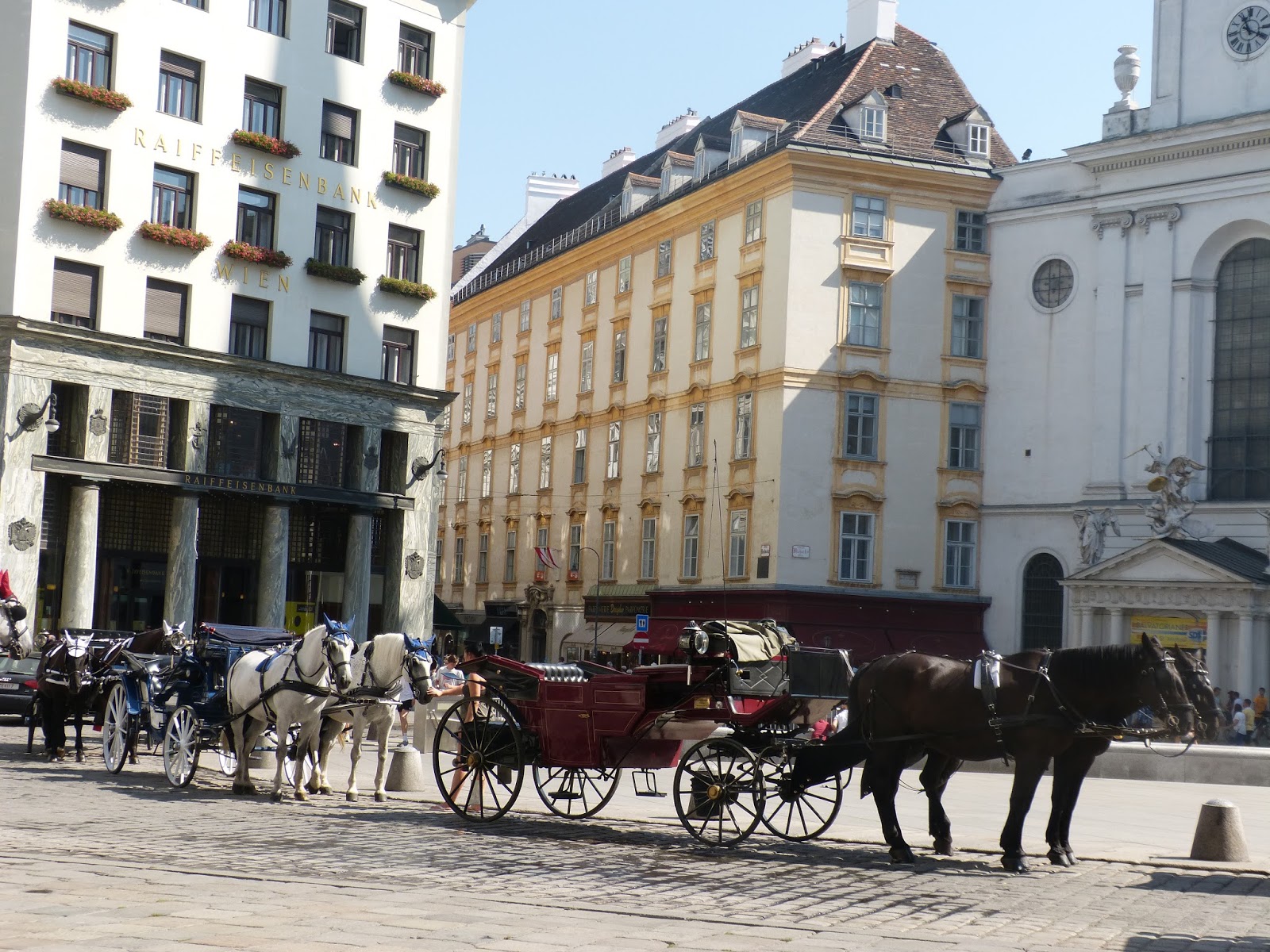
While we were in Vienna, we were struck by the horses that drew the visitor-laden carriages around. We particularly noticed them as our niece, whose marriage we attended at the end of the holiday, was very horse-mad as a teenager. She was even intending to become a mounted policewoman.

The animals looked well looked after. In the searing heat, around 35ยบC, they were supplied with plenty of water from standpipes found at the places they did their trips from. 

Stephansdomplatz,  waiting for passengers 

Stephansdomplatz,waiting  for  customers

Outside  the  Hofburg complex, with Michaelerkirche  in the background


Queueing  up in front of the Hofburg  Palace

The idea of such a ride looked wonderfully romantic, an echo of a past era, the time of the Austro-Hungarian Empire. However, trying to get into such carriages is totally impractical if you are a wheelchair user.

We assumed such horse-drawn carriages would only be available in Vienna, so imagine our surprise to see them available in St Wolfgang, a village in the Salzkammergut area near Salzburg.

Waiting at  St Wolfang
yy

Thursday, 1 October 2015

Inter-national influences


Some aspects of Austria reminded us of other countries, other holidays.

This struck us first in Vienna, when we saw Stephansdom, the cathedral. One of the wonders of the cathedral is its roof. This has glazed tiles. We were instantly taken back to our French holiday earlier this year, and the Hรดtel Dieu at Beaune. There, too, were magnificent glazed tiles. I did a little reading & discovered Maximillian I, ruler of Austria & emperor of the Holy Roman Empire, married Mary of Burgundy in 1477, not long after the hospital was founded. I find myself wondering if she didn’t bring with her a taste for some things that reminded her of her childhood home, such as these beautifully glazed tile roofs.

Stephansdom, Vienna

Hotel Dieu, Beaune

The other aspect that reminded me of elsewhere is the fact that the Austrians seem to share the same reluctance to leave any bit of bare plaster undecorated.
St Gilgen, Austria

St Wolfgang, Austria

Molveno, Italy
                                                                                                                                                                                                                                                
For that matter a plank of wood for them is an excuse to produce something more interesting. 

Hallstatt, Austria

Again there is maybe good reason why the one country should have influence the other. After all the Dolomites of Northern Italy were part of the Austro-Hungarian Empire for many years.


Whatever the reasons, one thing is for sure. These decorative features do make for a more visually exciting world.