The
time has come to tell you some of what we saw on holiday. I suppose logically I
should write the following blogs in the order they occurred, but I’m not going
to. You don’t need a blow by blow account of what happened. Instead I will
write of things that stand out for one reason or other.
I’m
going to start with the Hôtel-Dieu, mainly because this fabulous building was
one of the main attractions which drew us to this area in the first place.
We
had seen various pictures of the place in the background to various TV
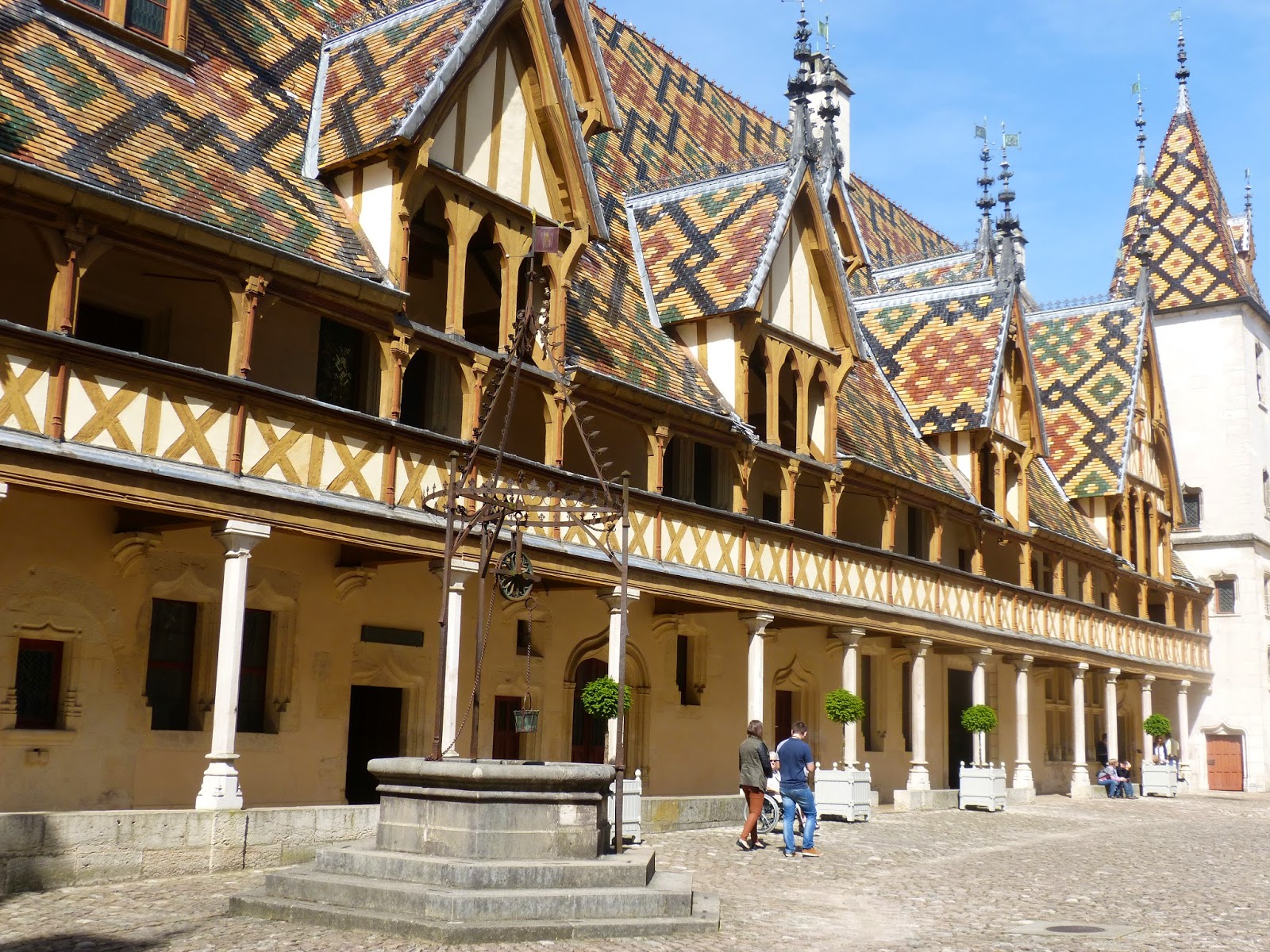
programmes (usually food or wine related). The colourful roofs are unmistakable.
The urge to visit was confirmed when we were in Tours last year & saw in
the Musée du Compagnonnage a cake shaped & decorated as the Hôtel-Dieu. We
knew this was one place we wanted to see & didn’t fail to delight us.
 |
| Hotel-Dieu |
 |
| Hotel-Dieu, along short side of quadrangle |
 |
| Detail of roof |
 |
| Detail of slate roof |
We
were surprised to learn that in fact it is the slate roof on the road side of
the building that was the expensive roof when the building was founded in 1443.
I suppose when I think about it I can see slate is not a local material so it
would have had to be brought into the area with all the costs that would
involve. Clay, on the other hand, could be found locally, made into tiles &
glazed to make the colourful roofs which now so epitomise the building. (We
were surprised to discover how common these colourful roofs are in this part of
Burgundy though they seem to be being replaced by more usual plainer roofing
materials these days.)
So
what is the Hôtel-Dieu? It was built to be a hospital, which it remained until
1982. It shows great foresight on the part of Chancellor Nicholas Rolin &
his wife to have produced a building that could have been adapted to keep with
the needs of a hospital through all those years.
The
ward covered by the slate roof was free to the sick from the start – a sort of
early NHS – treatment being subsidised by the private wards. Over the years
much lands, & valuable vineyards, have been left to the hospital. The money
raised all goes to support & maintain the hospital, though this building is
now just a museum & has largely been restored to what it would have been
like in the 15th century.
 |
| The Chambre des Pauvres, the Poor Ward |
The
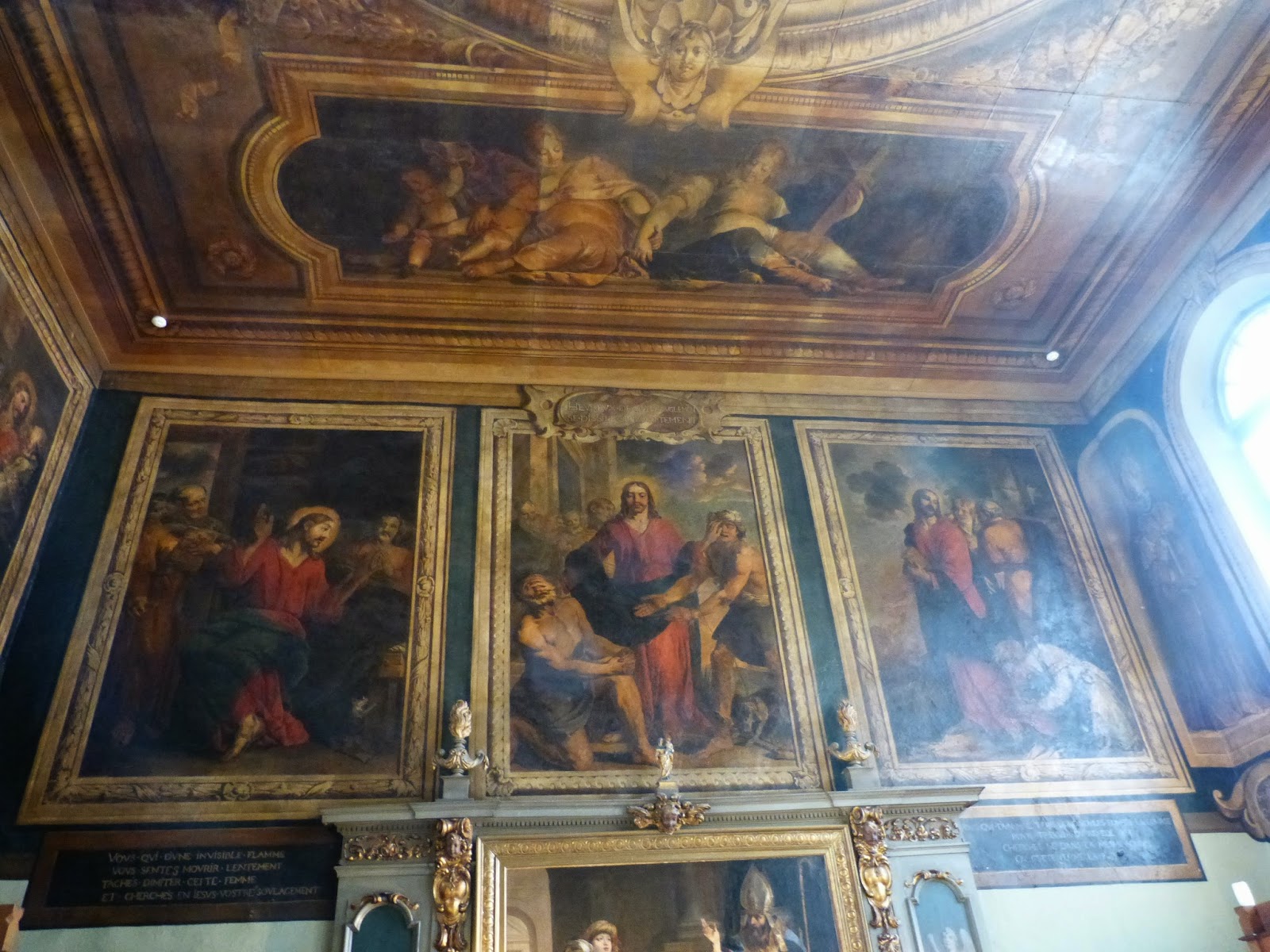
Salle St Hugues was the last ward to be closed. It was used until 1982 for the care
of the elderly who were no longer able to look after themselves. Personally I
think living surrounded by all that religiosity would have got me down if I had
to live there for long.
 |
| Salle St Hugues |
 |
| Salle St Hugues |
The
nursing staff were nuns, not surprising when you consider the time at which the
place was founded. The stiff starched linen veils remained the same until the
end.
 |
| Nun treating a man in the Poor Ward |
 |
| Nun & patient in the 20th century |
As
we went round we saw the laboratory, pharmacy, kitchens etc.
 |
| The laboratory |
 |
| The pharmacy |
 |
| The kitchen. Rabbit for dinner. |
 |
| Kitchen |
 |
| In kitchen, the inevitable washing up |
Eventually we
ended up in the converted warehouse part of the hospital. Now it is an
exhibition space for the tapestries, medical equipment etc. In the Salle du
Polyptygue is the fabulous “Last Judgement” by Roger van der Weyden.
 |
| "Last Judgement" by Roger van Weyden, polyptych inside |
This
magnificent piece was originally kept on the chapel altar. The polyptych was
opened up for special religious days. Otherwise it was left closed, showing the
images of Chancellor Rolin & his wife Guigone de Salins.
 |
| Polyptych outside with Rolin & his wife Guigone |
In this room, too, are
some fabulous tapestries which once had graced the hospital walls.
We
spent a couple of hours going around the place. If the audioguide is accurate,
the love between Rolin & Guigone was deep. The hospital was well thought
out, with a good well inside & running water to flush out the effluent etc.
I still can’t quite believe that it was built so early & yet capable of
being used as a hospital until so recently. And Rolin & Guigone spared no
expense on the decoration of the whole, not just the wards for the rich, but
also for the poor. The built a place for the glory of God as well as a place to
fulfil the medical needs of all. These wards have seen so many plagues, so many
wars over the years, & still kept going on.
 |
| Roof & tie-beams in Poor Ward |
 |
| Decorated tie-beam in Poor Ward |
 |
| Belfry in slate roof above the Poor Ward |
 |
| Well in courtyard at the centre of the quadrangle |