Wednesday, 9 October 2013

Encounters, new & old


There are times it strikes you just how good it is to be home. I seem to have been writing about France so much of late. Much as I love France, England, particularly Lancashire, remains home.

This thought struck me over dinner. We had a Ham & Egg Flan, made with an old Mrs Beeton recipe. The clean fresh taste of the simple egg custard made the flan. It had no fancy spicing or herbs, no cheese, nothing but egg & milk with a bit of salt & pepper. It seemed so English, so unspoilt.

We’d had a pleasant afternoon at our village pub, talking to the new barmaid. She’s a recent graduate, working part time at the pub. Her main job is in the management of the local council fitness centre, but she needs the extra money to pay off some of her student debts. She’s not unduly worried about the student loan. That she accepts will, or will not, be paid off over the course of her career. It’s the credit cards & overdraft she’s more concerned about.

It was lovely to see her enthusiasm for life. It’s the first time I’ve really regarded sport as a degree course, yet that was what she had a degree in. She certainly had the intelligence & intellectual rigour of anyone who has gained a more orthodox degree.

Today I was pleased to see a letter from the hospital arrive. It’s my appointment for another ultrasound scan. This should reveal whether my pancreas is once more down to more normal size & I can start to have a little bit of alcohol again.

 It’s not that I’ve ever drunk much alcohol, but I do miss my glass of wine with dinner. I resent having a range of experience & a chance of discovering new tastes denied me. It also makes such things as communion wine forbidden, not to mention some fabulous desserts & chocolates. I don’t want a lot. I just want to be free to have the choice again.


Tuesday, 8 October 2013

I wonder....


There remains one more observation – or is it really question – arising from our recent holiday.

As I said afew blogs back, I was reading Pagnol’s “The Water of the Hills” set, i.e. “Jean de Florette” & “Manon des Sources”. One of the things that clearly comes over in these books is the deep suspicion & rivalry between two neighbouring villages. Part of the reason why what happened was allowed to happen was that Jean, not only came in from outside, he was born in that neighbouring village which inevitably made him the most despicable of all foreigners.

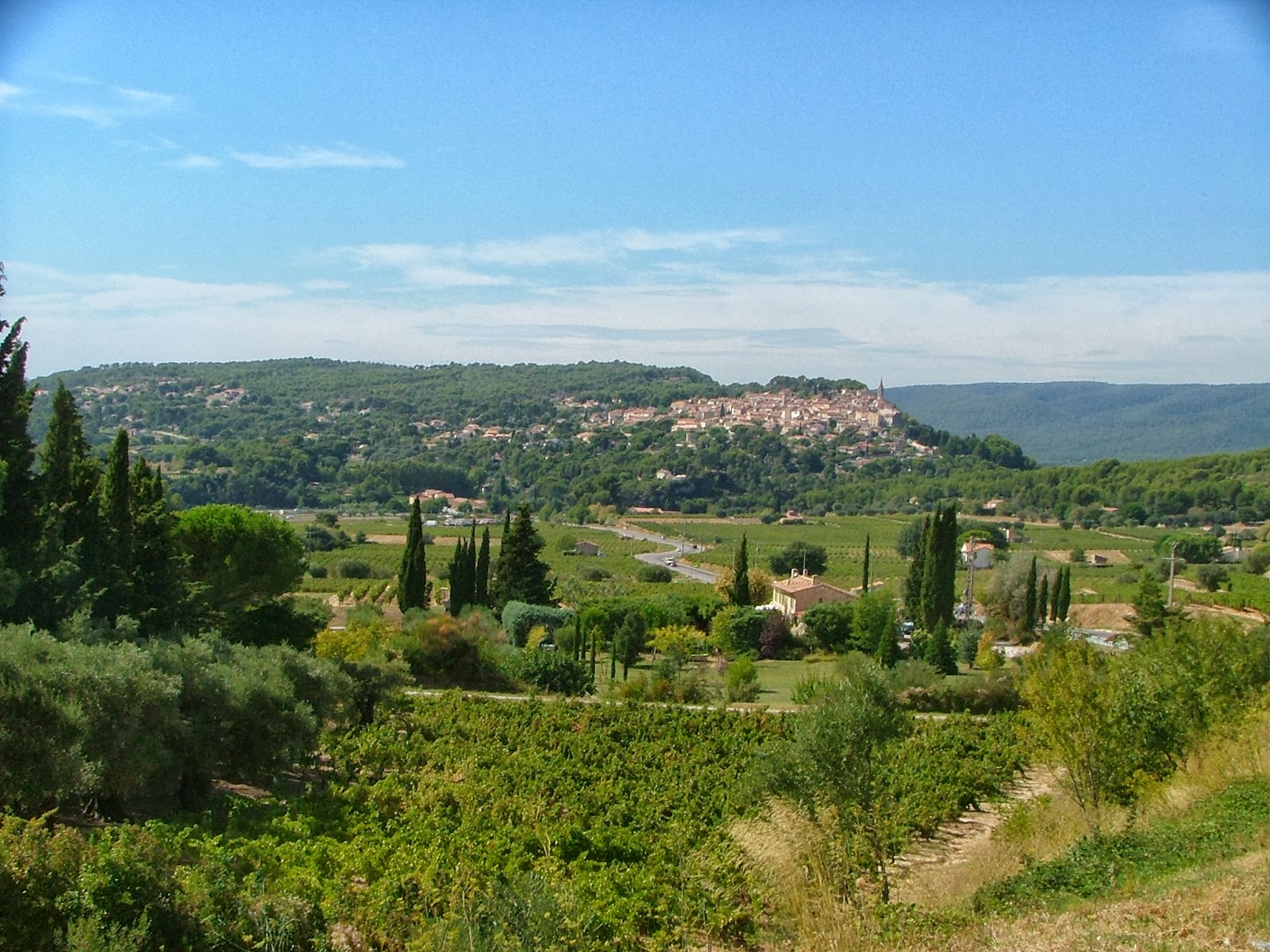
La Cadiere d'Azur

Le Castillet from La Cadiere d'Azur


La Cadière d’Azur, where we were staying, is a perched village. Across the valley is another perched village, Le Castillet. Both were clearly highly fortified. 


The 8th century Porte St Jean, La Cadiere


La Porte Mazarine, also in La Cadiere


I found myself wondering who they were fortified against. Did similar rivalry exist between villages, resulting in occasional raids on each other? Or were they both trying to protecting themselves against a common enemy, rampaging & pillaging its way north into the heart of France? I wonder…

Monday, 7 October 2013

Pieces of rock


I suspect this is going to be my last holiday blog.

One thing that struck me while we were in Provence is a particular rock formation. Somehow it kept appearing in the background. I was reminded of that fact when we looked through our photographs. This rock formation is so distinctive it’s quite unmissable.

From the Cassis end of the Route des Cretes
Taken from Les Lecques


As far as I can tell the rocks are just behind La Ciotat. I say this from some of the paintings done by Courdouan who I mentioned in the first of my Provençal blogs. Wherever they are, they are certainly impressive, dominating the surrounding countryside for miles around.

Friday, 4 October 2013

Eating out


We’re back to classic North Lancashire weather i.e. rain, so different from the weather in Provence. It seems another world almost.

In his blog the Fox has already touched on one of the delights of holidaying in France, in Provence in particular, and that is eating out. I mean literally eating out under the stars.

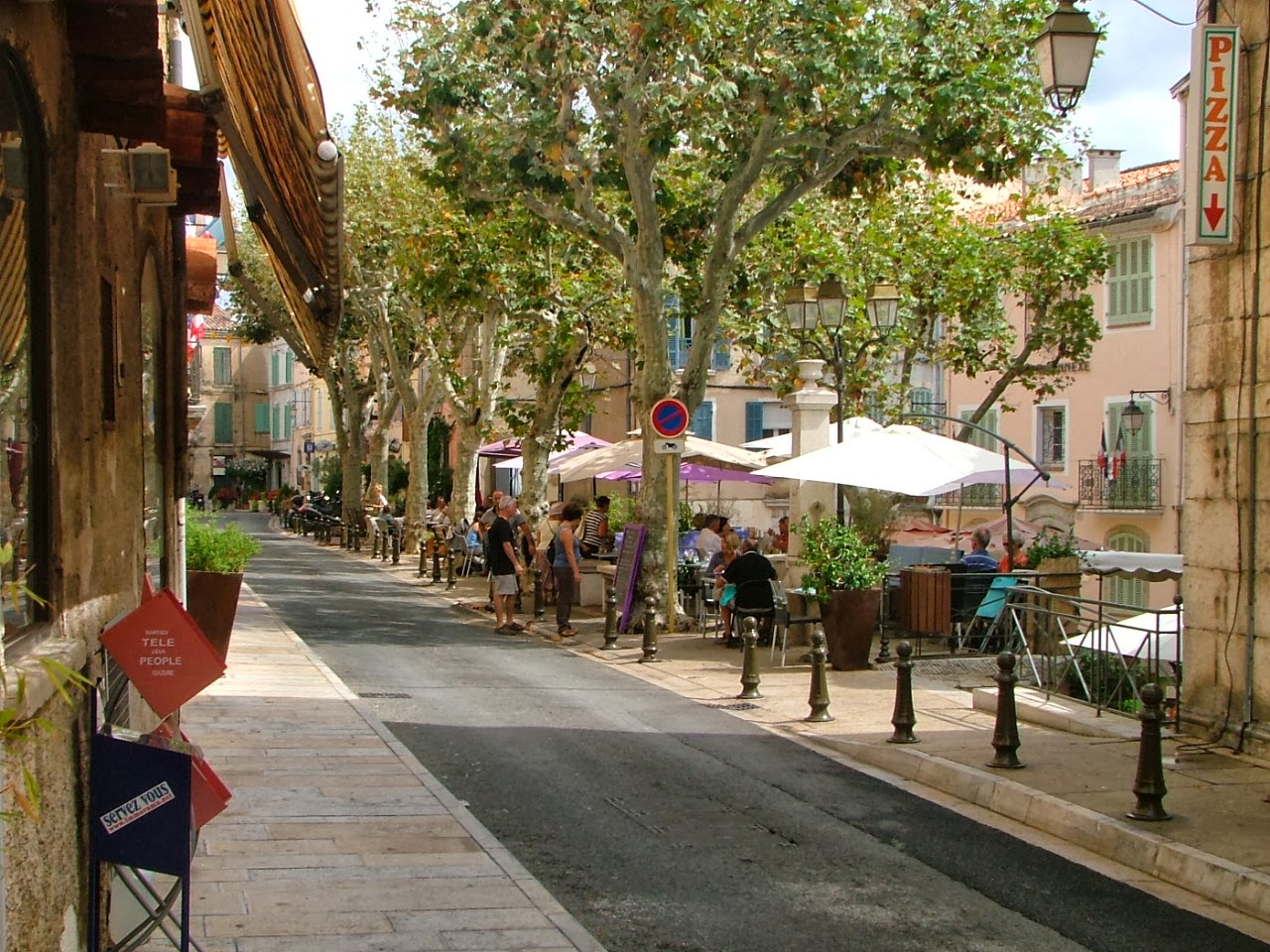
On this holiday we did eat at restaurants a bit more often than on some holidays. Our favourite restaurant was “La Chaise Bleue” (the Blue Chair) at La Cadière d’Azur. The actual inside was too small for any tables so all the tables at the restaurant are laid out on the street. We gained our regular table next to the fountain.

 
Dining area at the Chaise Bleue


Where the food is cooked. I do like the blue chair on the wall


We go to know Eric & Brigitte (yes, she was named after Brigitte Bardot), the waiting staff. The chef came out to talk to his customers. Once he got over the shock of realising we could speak French, he became much friendlier & keen to discuss our local culinary specialities i.e. potted shrimps, & rugby (his other passion). Indeed on the last day we had to go to wish them all farewell. Brigitte reckons the good thing about saying goodbye is that you now have a reason to come back – to see friends once more. After our first night there we were given a complimentary glass of champagne to start every meal. I confess I slipped a bit & did have a sip on each occasion although the Fox had the rest. There were no adverse repercussions.

There was another restaurant in La Cadière, we tried a couple of times. On both occasions we weren’t entirely happy. We were tempted to the second visit only because it did have an inside & the mistral wind was blowing coldly that day so we wanted to escape inside. 

There were two other restaurants in La Cadière, both expensive. One was a Michelin 2-starred Hôtellerie. It looked very fancy, too fancy for us in holiday mood. The other was the brasserie belonging to the Michelin starred Hôtellerie. That required negotiating numerous steps, not a task we fancied with me in a wheelchair. A couple of burly Frenchmen did see us looking at the menu & insisted on taking us in, to discover the restaurant was full so there was no table for us. They helped us down again. We headed back to the Blue Chair.

Why we explored the culinary delights of La Cadière d’Azur was because that was the village we were actually staying in so it was a short, if hilly, stroll back afterwards.

La Cadiere d'Azur on its hilltop

We did try eating out elsewhere, once for lunch at a village on the way to Le Val. We do try to convince ourselves lunch would be a good idea. The meals are often cheaper & so much of Provence closes down for lunch between 1 and 4pm. However our stomachs are used to a more substantial meal in the evening & rebel against the change of time. A snack at lunchtime is one thing, a meal is another.

Our last night we decided to try an auberge we’d passed several times on the way to Bandol. We thought the Chaise Bleue would be a bit too emotional stressful for that night & anyway we fancied trying something different. The entrance to this auberge had caught our eyes & intrigued us. We couldn’t help thinking next time we go to France maybe this was the sort of place we ought to stay – a family-owned auberge (inn) where the people are very French, there is food on site & there’s no need to worry about the shopping, bed-making, cleaning etc that self-catering involves.

Thursday, 3 October 2013

Water, water


While we were in France, I was reading Pagnol’s “Jean de Florette” & “Manon des Sources”. We’ve had these books since the well known films came out. I have resisted reading them as the films were so vivid, but I decided the time had come to do so. It seemed appropriate as Pagnol came from Aubagne, not far from where we were staying. The landscape described in these two books, as with so many of his books, was the sort of terrain in which we were staying. I confess I also resisted reading the books as Pagnol’s “La Gloire de mon Père” was one of my ‘A’ level set books & I hated it.

For those who haven’t seen the films or read the book, water is almost a character in itself. The disaster that befell Jean was largely the result of lack of water, a lack that resulted from a greed for more water. In the second book Manon uses water to try to get some sort of justice for her, by then, dead father Jean.

Reading these two books made me very aware of just how important water must have been for the area in the days before regular piped water. This was emphasised by seeing the huge walls of the reservoir of La Cadière d’Azur, as strong & imposing as any medieval castle wall.
 
Reservoir walls La Cadiere d'Azur

Visiting the village of Le Val, near Brignoles, we did the short walking tour, recommended by the Office de Tourisme. One of the things that became apparent was that the village attributed much of its wealth & growth to the fact that there are more than a dozen springs in the village.

Water is such a central part of life, essential for life itself in man, animal & crop alike. So many industries also require a certain amount of water. Water was also the source of power in so many places with watermills, though clearly most of the olive mills around this part of Provence were wind-powered. It is also essential for washing. This ancient wash-house remains standing, though recently renovated by the looks of it.
 
Wash-house at Le Val

 couldn’t help thinking how many places in France, especially in Provence, we have seen great fountains from long ago. In England you tend only to see fountains that have been installed as decorative features. Their useful ancestors got cleared away with the advent of piped water. Not so in France. Here the importance/significance of water is still celebrated. Every town, every village, still seems to have its ancient fountain, where people for hundreds of years have been to collect there daily water.

I suppose, too, I have to admit the sun shone throughout our holiday. We had a couple of nights of rain, but that was it. It’s not like the north of England, where it’s a relief to have a few days without rain. We tend to take water for granted as a result. And not only, did the sun shine warmly, the mistral wind blew which must have an even more dehydrating effect on the land.

All in all, these observations made the plight of poor Jean de Florette all the more poignant.

Wednesday, 2 October 2013

Around & around we go


One of the things that always seems to strike me in Provence is the proliferation of carousels. I seem to be making a photographic compilation of them. I’ll start with a picture that regular long-established readers of my blog may find familiar as I included it in my blogs from our last trip to Provence in 2010.

 
A magnificent example in Nice


In the seaside towns we visited in Provence this time, the theme of Jules Verne seems to have predominated. I wonder why. If anyone knows please let me know.


The one at Bandol

And so to Cassis


Still at Cassis

Now we're at Sanary sur Mer

  
I love the fact that these carousels both continue to exist, & are in working order, still enjoyed by today’s children. I also love the colour & the music that goes with them. They cheer the soul. I love the fact they come single- & some double-tiered, presumably according to the size of the venue they are in & the money available to set one up.

Tuesday, 1 October 2013

The Wave


Life is slowly getting back to something like normality. Maybe it’s just I’ve got some curried meatballs, an old favourite, plopping away ready for dinner tonight. Maybe, too, it was popping over to Snatchems yesterday. We watched over a hundred Canada geese on the estuary. As some fed, their long necks disappeared into the waters. The next thing was they overbalanced, ending up doing a somersault in the river landing up on their backs. We couldn’t help laughing.

I thought today I would say something about our holiday. There are two things that particularly stick out for me, so here comes number one.

One day we went over to the Centre d’Art Sébastien in Saint Cyr sur Mer. Sébastien (1909-1990) is not an artist I’ve come across before. I gather from the leaflet we were given he was a friend of Picasso, Cocteau & André Gide.
 
Centre d'Art Sebastien

This small gallery, just four rooms, had one room devoted to the works of Sébastien himself. The image that particularly stays in my mind was “La Vague” (The Wave). It was a sculpture in a pinkish beige stone. It depicted a swirling shape, a sea wave. In the midst was a beautiful woman’s face, arms swirling with the wave. Her left arm pulled over a hood of water. In her right arm she cradled & protected a fish. The whole image was truly beautiful. It haunts me still.

Gide described Sébastien’s work as mystico-sensual. There certainly was sensuality about this sculpture. The urge to stroke the sculpture was almost overwhelming. The woman was presumably some sort of mermaid or sea nymph.

Other examples of his sculpture had similar sensuality. On one wall there was an exploration of the number 8, the way the lines curve & cross over to form the figure.

The rest of the gallery was devoted to the temporary exhibition entitled “Les Voiles de la Mediterranée” (The sails of the Mediterranean). One room was essentially devoted to the Corderie de Toulon (17th century rope making factory in Toulon) & a bit of naval history of the time. Since we had seen a similar exhibition at the Corderie Royale at Rochefort in the Charente some years ago we didn’t stay long in this room.

The second room was a selection of paintings by various artists & from various times, on the theme of the French Mediterranean coast. Some pictures were impressive. I remember especially seeing the orange light streaming out behind the sail of one fishing boat. And another huge painting of fishermen bringing in the nets full of tuna.

The last room was devoted to Vincent Courdouan (1810-1893), again an artist I hadn’t knowingly encountered before. Most of his works – all those shown here – were on the subject of the life & scenery around Toulon, where he was born & where he became the curator of the Musée de Toulon in 1852. He clearly had good technique. His watercolours glowed. A picture of 19th century Provence emerged. It is so different from today. Small fishing villages are now overflowing with tourists, shooting up modern hotels. It clearly was a backwater area in those days.

So that is my first image of Provence from this holiday. I’ll write another, another day.